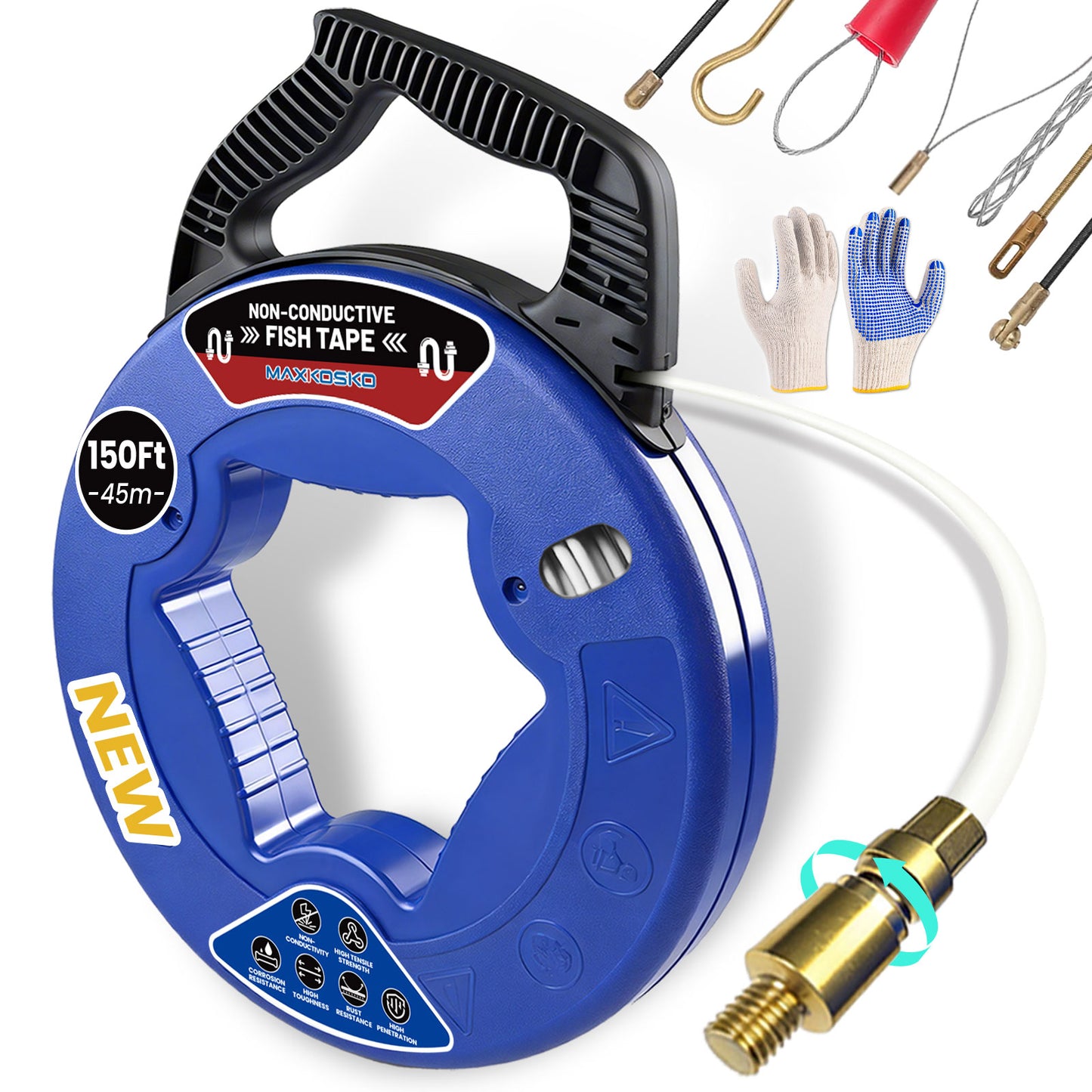
Professional Fiberglass Fish Tape with Rotating Leader
MAXKOSKO Professional Fiberglass Fish Tape is designed for pulling electrical wire and communication cable through conduit, walls, ceilings, and other difficult routing spaces.
The non-conductive fiberglass tape combines useful stiffness with greater flexibility than carbon steel, while the 360-degree rotating leader helps guide the tape through bends and reduce snagging inside crowded conduit.
Non-Conductive Fiberglass
Fiberglass construction provides a non-metallic alternative for electrical and low-voltage wire pulling projects.
360° Rotating Leader
The flexible multi-directional head helps navigate bends and changing conduit directions with less snagging.
Balanced Flexibility
Provides enough stiffness for pushing while remaining flexible enough for more complex cable routes.
High Pulling Strength
Designed to withstand demanding wire pulling tasks without the permanent bending commonly associated with steel tape.
Impact-Resistant Case
The enclosed reel protects the fiberglass tape during transport, storage, and everyday jobsite use.
Ergonomic Rewind Handle
The comfort-grip case and angled handle support smoother payout and faster tape retrieval.
Important Before Ordering
Confirm the Material and Route Requirements
Non-Conductive Does Not Mean Live-Circuit Safe: Disconnect, lock out, and verify electrical power is off before inserting the fish tape. Never rely on the tape material as your only electrical protection.
Best for Complex Routes: Fiberglass is recommended for conduit containing bends, direction changes, or areas where a flexible rotating leader can improve navigation.
Avoid Kinking: Do not sharply fold, crush, twist, or force the fiberglass tape beyond its natural bending range. Internal damage can reduce strength.
Do Not Force a Blockage: Stop if the leader becomes firmly stuck. Pulling or pushing with excessive force may damage the tape, conduit, or installed wiring.
Choose Carbon Steel for Maximum Rigidity: For long, relatively direct conduit runs where stronger pushing power is the priority, carbon steel may be the better choice.
Product Specifications
| Product Type |
Professional Fiberglass Fish Tape |
| Tape Material |
Fiberglass Core with Protective Outer Jacket |
| Electrical Conductivity |
Non-Conductive Material |
| Leader Type |
360° Multi-Directional Rotating Leader |
| Case |
Impact-Resistant Enclosed Reel |
| Primary Use |
Electrical Wire and Communication Cable Pulling |
| Recommended Routes |
Conduit, Walls, Ceilings and Routes with Multiple Direction Changes |
Fiberglass or Carbon Steel Fish Tape?
Choose Fiberglass
Recommended when non-conductive material, improved flexibility, and easier navigation through bends are the main priorities.
Choose Carbon Steel
Recommended when maximum rigidity and stronger pushing power are needed for long or relatively direct conduit runs.
Need a more rigid wire pulling tool? View the MAXKOSKO Carbon Steel Fish Tape.
Recommended Applications View Applications Hide Applications
- Electrical wire pulling through conduit
- Communication and low-voltage cable routing
- Walls, ceilings, attics, floors, and crawl spaces
- Residential and commercial wiring projects
- Conduit routes with bends or direction changes
- Renovation, construction, and general maintenance work
Frequently Asked Questions
What is the main advantage of fiberglass fish tape?
Fiberglass provides a non-conductive material with greater flexibility than steel, making it suitable for conduit routes with bends and direction changes.
What does the rotating leader do?
The multi-directional leader can rotate as it moves through conduit, helping the tape follow bends and reducing the chance of the tip catching on conduit joints or existing cable.
Can this fish tape be used on energized circuits?
No. Although fiberglass is non-conductive, the circuit must still be disconnected and verified de-energized before wire pulling begins.
Can fiberglass fish tape be sharply bent?
No. Avoid sharp folds, kinks, crushing, and excessive twisting. These actions can damage the internal fiberglass core.
When should I choose carbon steel instead?
Choose carbon steel when your project has a long, relatively direct route and requires greater stiffness and stronger pushing power.