


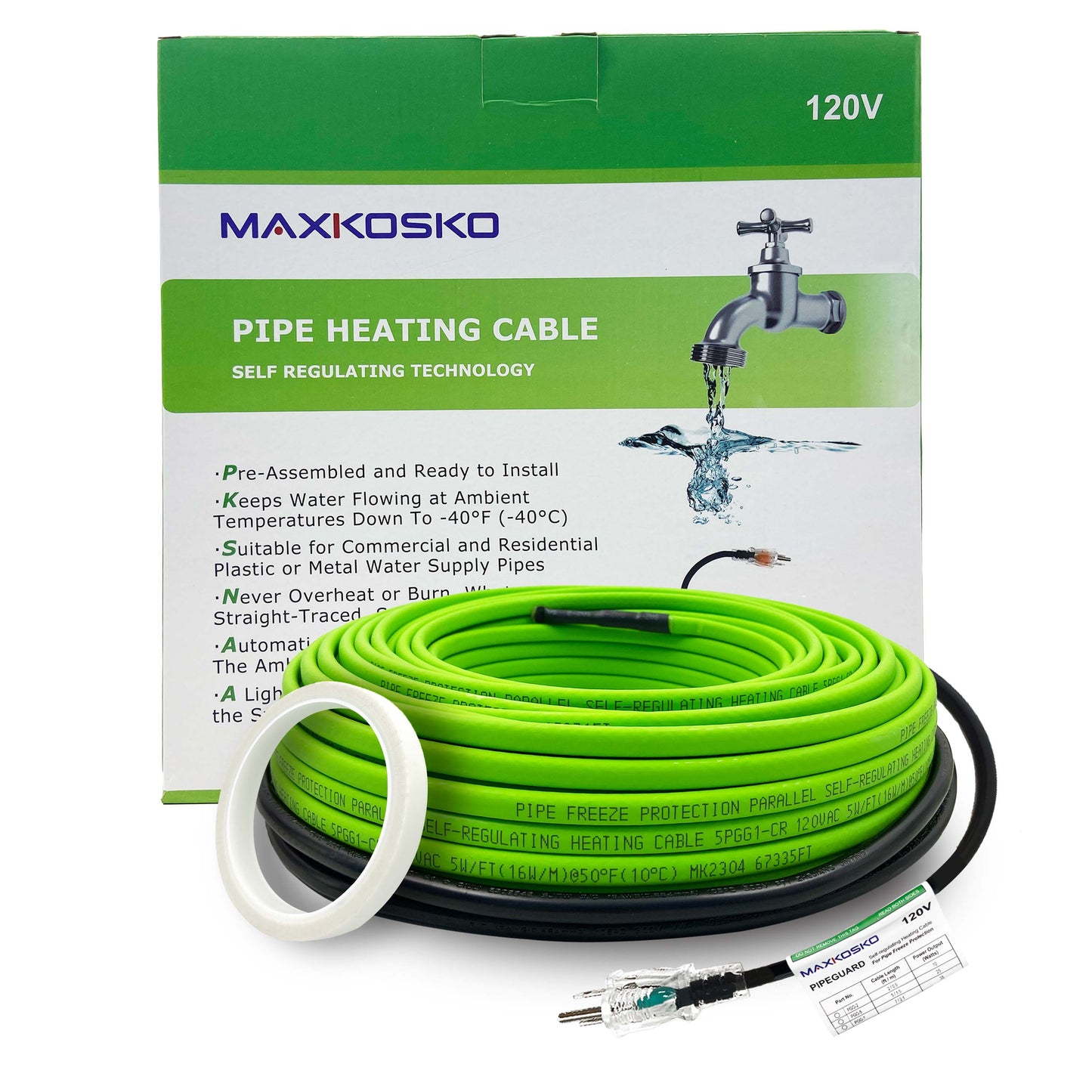
Description
120V Self-Regulating Pipe Heat Cable without Thermostat
MAXKOSKO Green Pipe Heat Cable provides continuous self-regulating freeze protection for compatible metal and rigid plastic water pipes.
This model does not include a built-in thermostat. Once connected to power, the cable begins operating and automatically adjusts its heat output according to pipe and ambient temperature.
For automatic on-and-off control, pair it with the MAXKOSKO 120V Pipe Heating Cable Thermostat Controller.
No Built-In Thermostat
Begins operating whenever connected to power, making it suitable for external switches and temperature controllers.
Self-Regulating Output
Produces more heat in colder areas and reduces heat output as pipe temperature rises.
6 ft Power Cord
Provides greater reach between the heating section and a suitable 120V outlet.
Multiple Installation Styles
Supports straight tracing, spiral wrapping, and approved overlapping installation.

Important Before Ordering
This Cable Does Not Automatically Turn Off
Heats Whenever Powered: Once plugged in, the cable starts operating. The indicator light confirms that power is connected.
Self-Regulating Is Not Auto-Off: The cable changes its heat output but does not completely shut itself down. Disconnect power or use a compatible controller when heating is not required.
Recommended Controller: For automatic temperature-based operation, use the 120V Pipe Heating Cable Thermostat Controller.
Heating Length Only: The selected size refers to the heating cable. The attached 6 ft power cord provides additional non-heating reach.
Pipe Insulation Required: Suitable nonflammable insulation and weather protection are required after the cable is secured to the pipe.
120V GFCI Protection: Use only with a grounded 120V outlet protected by an appropriate ground-fault device.
Select the Correct Length: Plan the complete pipe route before purchase. Do not energize a cable with an improperly cut or unsealed end.

Choose the Right Pipe Heating Cable
Want Built-In Automatic Control?
Choose the blue model with a mechanical pipe thermostat.
Want Separate Heating Indicators?
Choose the upgraded dual-LED model with built-in thermostat and separate power and heating lights.
Need 12V DC Power?
Choose the low-voltage model for RVs, boats, batteries, and off-grid water systems.
Add Automatic Control
Pair this non-thermostatic cable with an adjustable sensor controller for automatic operation.


Specifications
| Product Type | Self-Regulating External Pipe Heating Cable |
| Rated Voltage | 110–120V AC |
| Rated Output | Approximately 5W/ft at 50°F and 6W/ft at 40°F |
| Built-In Thermostat | No |
| Operation | Begins Heating Whenever Connected to Power |
| Power Cord Length | 6 ft, Additional to the Selected Heating Length |
| Installation Methods | Straight Trace, Spiral Wrap or Approved Overlap |
| Compatible Pipes | Compatible Empty or Water-Filled Rigid Metal and Plastic Pipes |
| Included Accessory | Approximately 33 ft Glass Cloth Installation Tape |
| Recommended Control | Optional 120V Thermostat Controller |

Basic Installation Requirements View Requirements Hide Requirements
- Measure the complete pipe, valves, and supports before selecting a cable length.
- Install the cable straight, spiraled, or in an approved overlapping layout.
- Secure the cable approximately every 6 inches using suitable tape or ties.
- Cover the full pipe and cable with appropriate nonflammable insulation.
- Place an external controller sensor directly against the protected pipe when automatic control is used.
- Disconnect power when freeze protection is no longer required.
- Read the complete manual for pipe-size and low-temperature length calculations.

Frequently Asked Questions
Does this cable include a thermostat?
No. It operates whenever connected to power. Use a separate switch or compatible 120V temperature controller when automatic control is required.
Does self-regulating mean the cable turns itself off?
No. It reduces heat output as temperatures rise but may continue consuming power until it is disconnected or switched off by an external controller.
What does the indicator light show?
The light confirms that power is connected. Because this model has no thermostat, the cable begins operating whenever the indicator is on.
Can it be installed on an empty pipe?
Yes. It can be used on compatible empty or water-filled rigid metal and plastic pipes when correctly installed and insulated.
Can the cable overlap?
Yes, the self-regulating cable supports approved overlapping installation. Do not leave excess cable tightly coiled during operation.
Which controller should I use?
Use a compatible 120V controller with sufficient electrical capacity, such as the MAXKOSKO Pipe Heating Cable Thermostat Controller.
Before Installation
Confirm the pipe material, diameter, total route length, lowest expected temperature, insulation requirements, and controller preference before ordering.
This model is best for customers who want continuous operation or prefer to control the cable using a separate thermostat.

Frequently Asked Questions (FAQs)
-
Q1: What should I do if I finish wrapping the heating cable around the insulated water pipe, but there’s still some leftover cable?
A1: If it's not too much trouble, the best option is to unwrap and rewrap the cable, ensuring the wraps are slightly denser to fully utilize the remaining heating cable. This maximizes the efficiency of the heat produced.
A simpler option is to wrap the leftover cable back around the end section; overlapping is not a concern since our heating cable is self-regulating. This will generate additional heat, causing the cable to sense the increased temperature and lower its output power.
The final option is to cut off the excess cable. If you choose this method, make sure to seal the cut end with a waterproof end cap to prevent water ingress.
Please note that cutting should only be done with self-regulating heating cables; constant wattage cables should not be cut.
-
Q2: My heating cable is self-regulating, why do I still need a controller?
A2: Self-regulating cables adjust their power output with temperature, but they are always on and constantly consuming energy. A controller only activates the system when heating is truly needed, based on sensors, which helps save significant energy.
Plus, controllers offer many other benefits, see below for details: Adjustable Thermostat for Pipe Heat Tape