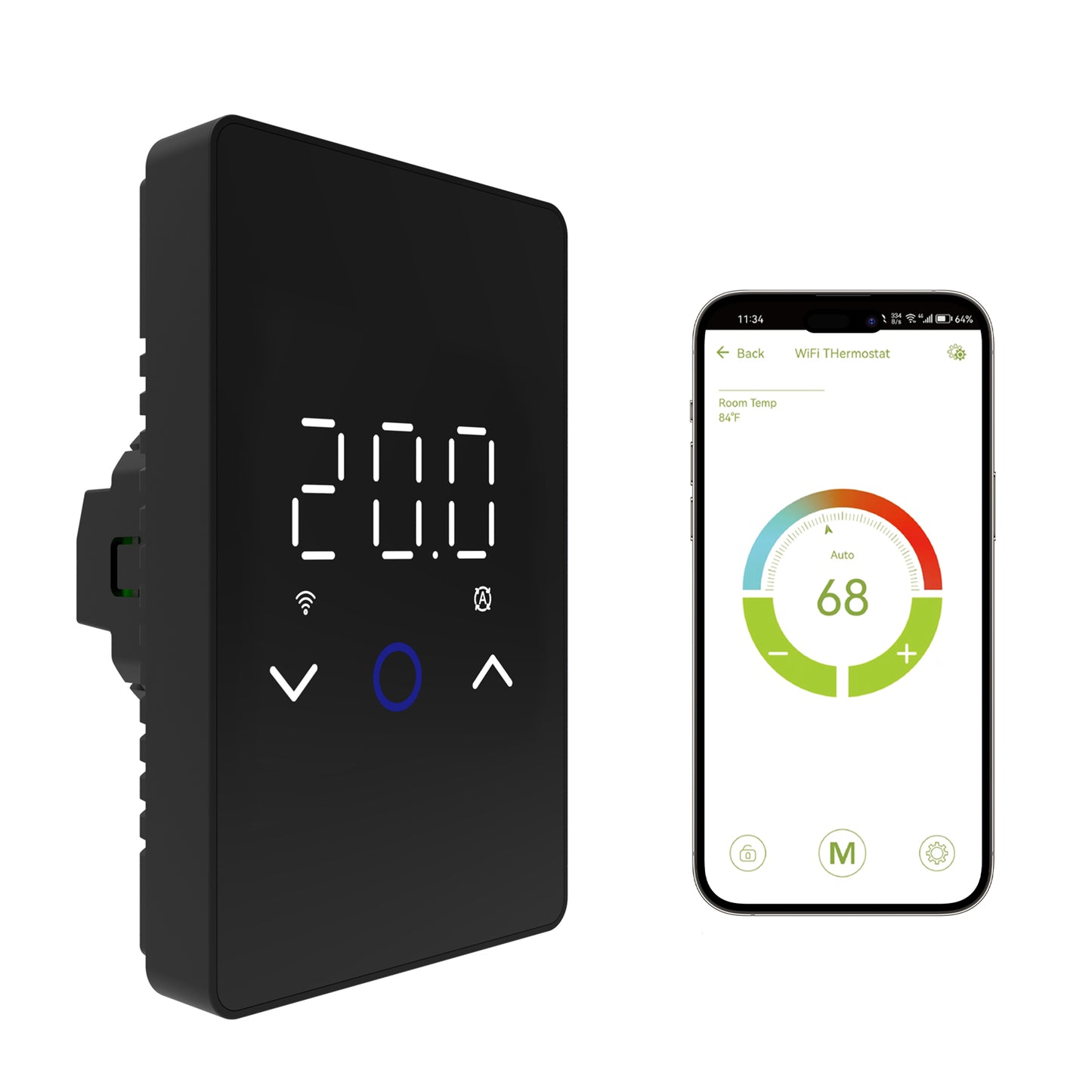
Choosing between floor sensor vs room sensor thermostat control depends on what you want the electric floor heating system to regulate. Floor Mode controls from the sensor installed in the floor. Room Mode controls from the air sensor inside the thermostat. Both or Combined Mode controls room temperature while using the floor sensor as a maximum floor-temperature limit. The right choice depends on your heating goal, flooring requirements, sensor installation, and system design.
Floor Sensor vs Room Sensor vs Both Mode: What Changes?
The MAXKOSKO ES29AW has two temperature-sensing sources:
- An external sensor installed in the heated floor assembly
- An internal room-air sensor built into the wall thermostat
The selected sensor mode determines which temperature the thermostat uses to control the heating system.
| Sensor Mode | Primary Control Sensor | Floor Sensor Role | Typical Control Goal |
|---|---|---|---|
| Floor Mode | External floor sensor | Controls heating directly | Maintain a selected floor temperature |
| Room Mode | Internal room sensor | Not used for direct floor-temperature control | Control air temperature around the thermostat |
| Both / Combined Mode | Internal room sensor | Limits maximum floor temperature | Control room temperature while maintaining a floor-temperature limit |
The Best Mode Depends on the Control Goal
There is no single sensor mode that is automatically best for every electric floor-heating installation. Start with whether your priority is floor comfort, room-air temperature, or room control with a maximum floor-temperature limit.
1. Floor Mode: Control From the External Floor Sensor
In Floor Mode, the thermostat controls the heating system according to the external sensor installed in the heated floor assembly.
This mode is useful when your main goal is maintaining a predictable floor temperature rather than directly controlling the air temperature of the room.
When Floor Mode May Make Sense
- The system is primarily being used for floor warming.
- Comfort underfoot is more important than maintaining a specific room-air temperature.
- A correctly installed and compatible floor sensor is available.
- The flooring and heating-system instructions support this control method.
Bathrooms and kitchens with compatible tile or stone floors are common examples of applications where floor-temperature control may be useful, but flooring material alone should not determine the sensor mode.
The Sensor Does Not Measure the Finished Surface Directly
The external sensor measures temperature at its installed location inside the floor assembly. Its reading can be affected by sensor placement, heating-cable spacing, floor construction, and surrounding materials. Do not assume the displayed value is an independent laboratory measurement of the finished floor surface.
2. Room Mode: Control From the Internal Air Sensor
In Room Mode, the ES29AW controls heating from the air-temperature sensor inside the wall thermostat.
The thermostat responds to the temperature around the wall unit rather than directly controlling from the embedded floor sensor.
When Room Mode May Be Considered
- Room-air temperature is the intended control variable.
- The installed floor-heating and flooring system permits operation without direct floor-sensor limiting.
- A usable floor sensor is not available and the installation requirements allow an alternative control method.
Room Mode Does Not Directly Monitor Floor Temperature
Because Room Mode controls from the wall thermostat's air sensor, it does not provide direct floor-temperature feedback. Do not use Room Mode as a way to bypass a required floor-temperature limit or ignore flooring-manufacturer instructions.
Room-sensor readings can also be influenced by thermostat location. Direct sunlight, exterior-wall conditions, drafts, nearby heat sources, or poor air circulation around the thermostat can affect the temperature it senses.
3. Both Mode: Room Control With a Floor Temperature Limit
On the MAXKOSKO ES29AW, Both Mode is also described as Combined Sensor Mode.
In this mode:
- The internal room sensor is used for normal temperature control.
- The external floor sensor monitors floor temperature.
- The configured floor limit restricts heating when the floor reaches that limit.
This can be useful when you want the thermostat to respond primarily to room-air temperature while also maintaining a defined maximum floor temperature.
When Combined Mode May Make Sense
- The room-air temperature is the main comfort target.
- A maximum floor-temperature limit is required or desirable.
- A compatible floor sensor is correctly installed.
- The limit is configured according to the flooring and heating-system requirements.
Combined Mode Does Not Create a Universal Safe Temperature
The thermostat can enforce a configured floor-temperature limit, but you still need to know the maximum temperature permitted by the actual flooring, adhesive, underlayment, and floor-heating system. Do not select a generic limit based only on the material name.

Do Tile, Wood, Laminate, and Vinyl Require Different Modes?
Flooring type matters, but it should not be reduced to a universal rule such as “tile always uses Floor Mode” or “vinyl always uses Combined Mode.”
The correct setup depends on:
- The flooring manufacturer's radiant-heating approval
- The maximum permitted floor or surface temperature
- The heating-system installation instructions
- The location of the floor sensor
- Whether the goal is floor warming or room heating
- The floor assembly and underlayment
Floor Comfort Is Often the Priority
Floor Mode can be a practical option when the installation is designed mainly for comfortable tile or stone temperature. Combined Mode may also be appropriate when room-air control and a floor limit are desired.
Verify the Manufacturer's Limit
For compatible engineered wood, laminate, vinyl, LVP, or other temperature-sensitive flooring, follow the flooring manufacturer's maximum-temperature requirements. Combined Mode can provide a useful floor limit when the complete installation supports that control method.
Thermostat Floor Limit vs Flooring Temperature Limit
These are two different specifications.
The current ES29AW provides a configurable floor-temperature limit range of 20°C (68°F) to 50°C (122°F).
That does not mean every floor covering can safely operate anywhere within that complete range.
| Specification | What It Means |
|---|---|
| Thermostat floor-limit range | The range of limit values the thermostat is capable of being configured to use. |
| Flooring maximum temperature | The maximum temperature permitted by the specific flooring manufacturer and installation system. |
| Heating-system limit | Any additional temperature restriction required by the heating cable, mat, adhesive, membrane, underlayment, or installation instructions. |
Set the system according to the most restrictive applicable requirement rather than assuming that the thermostat's maximum available setting is appropriate for the floor.
Floor Sensor Placement Affects the Reading
Sensor mode cannot correct poor floor-sensor placement.
For the current ES29AW installation guidance, the external floor sensor should be positioned inside the heated area between adjacent heating-cable runs without touching or crossing the heating cable.
If the sensor is too close to a heating cable, it may detect a locally warmer condition than the surrounding floor and cause the thermostat to reduce heating earlier than expected.
Other placement problems can include:
- Sensor outside the heated area
- Sensor touching a heating cable
- Sensor crossing the heating element
- Sensor installed near an unusual cold or hot spot
- Damaged sensor wiring
Plan Sensor Placement Before the Floor Is Closed
Once tile or another finished floor is installed, replacing or repositioning an embedded sensor can become difficult. Follow the heating-system and thermostat installation instructions before covering the floor.
Which Floor Heating Sensor Mode Should You Use?
Choose by control objective instead of automatically choosing by room name or floor material.
Decide What You Want to Control
If the goal is a specific floor temperature, start by evaluating Floor Mode. If the goal is room-air temperature, evaluate Room or Combined Mode.
Check Whether a Floor Limit Is Required
Review the flooring and heating-system instructions. If room control is desired while the floor must remain below a defined maximum temperature, Combined Mode may be the appropriate control strategy.
Confirm the Floor Sensor Is Available and Compatible
For Floor or Combined Mode, the external sensor needs to be correctly installed, connected, and compatible with the thermostat.
Check Thermostat Location
Room and Combined modes depend on the internal air sensor, so thermostat placement should represent the room reasonably well and avoid unusual local heating or cooling influences.
Set the Correct Floor Limit
When using Combined Mode, configure the maximum floor temperature according to the actual flooring and heating-system instructions rather than copying a generic value from another installation.
Quick Sensor Mode Selection Guide
| Your Goal or Situation | Mode to Evaluate |
|---|---|
| Maintain comfortable floor temperature | Floor Mode |
| Control primarily from room-air temperature | Room Mode, if permitted by the floor system |
| Control room temperature while limiting floor temperature | Both / Combined Mode |
| Temperature-sensitive flooring with a specified maximum temperature | Evaluate Combined Mode and configure the required floor limit |
| Floor sensor is displaying an error | Troubleshoot the sensor rather than simply changing modes |
| Replacing a thermostat while keeping an old floor sensor | Confirm sensor resistance compatibility before selecting Floor or Combined Mode |
What If the Floor or Room Temperature Reading Looks Wrong?
The ES29AW provides separate Room Calibration and Floor Calibration settings.
Calibration can be useful when a working sensor has a small, consistent offset, but it should not be the first response to a large or unstable temperature error.
Before calibrating, check:
- The selected sensor mode
- The selected floor-sensor resistance type
- Sensor wiring and terminal contact
- Floor-sensor placement
- Whether an existing third-party sensor is actually compatible
- Whether the comparison temperature is being measured at the same location
Do Not Calibrate Away a Sensor Problem
If the displayed temperature is very abnormal, changes erratically, or does not correspond reasonably with the installed sensor, investigate the sensor type, wiring, placement, and compatibility first. Calibration should not be used to hide a damaged or mismatched sensor.
Replacing an Existing Thermostat? Check the Sensor Before Choosing a Mode
An embedded floor sensor may look compatible with a replacement thermostat even when its electrical characteristics are different.
Different NTC sensors can use different nominal resistance values and resistance-temperature curves. If the thermostat is configured for the wrong sensor type, the displayed temperature can be inaccurate and the heating system may stop earlier or run longer than expected.
The included ES29AW floor sensor is the preferred option for a new installation. If an existing sensor must remain in place, confirm its specifications before selecting the corresponding sensor setting.
For the full replacement decision, read how to check floor-sensor compatibility before replacing an electric floor-heating thermostat.
Do Not Use Room Mode to Hide an E1 or E2 Sensor Error
If the thermostat reports a sensor fault, identify the cause before relying on a different sensor mode as a workaround.
On the current ES29AW:
- E1 relates to the internal room-sensor circuit.
- E2 relates to the external floor-sensor circuit.
An E2 condition can involve a disconnected sensor, loose terminal, damaged sensor lead, incorrect sensor setting, or incompatible replacement sensor.
Use the MAXKOSKO E1 and E2 sensor troubleshooting guide when an error code is present.
What If You Switch to Room Mode but the Room Still Feels Cold?
Changing sensor mode does not increase the heating cable's output or the amount of heated floor area.
If the floor warms but the room still cannot reach the desired air temperature, the issue may involve:
- Room heat loss
- Insufficient heated area
- System sizing
- Floor construction
- Insulation
- Climate conditions
For that problem, use the dedicated guide to why an electric heated floor may feel warm while the room remains cold.
Key Takeaways
- Floor Mode controls heating from the external floor sensor.
- Room Mode controls heating from the internal air sensor inside the thermostat.
- Both or Combined Mode controls room temperature while using the floor sensor as a maximum-temperature limit.
- No single sensor mode is automatically best for every installation.
- Flooring material alone should not determine the sensor mode.
- Follow the specific flooring manufacturer's maximum-temperature requirement instead of using one universal limit.
- The thermostat's available floor-limit range is not the same as the maximum temperature permitted by your flooring.
- Correct floor-sensor placement is important for reliable control.
- Calibration is intended for small consistent offsets, not damaged, incompatible, or poorly installed sensors.
- If a sensor error is present, troubleshoot the fault rather than simply changing sensor modes.
Need Floor, Room, and Combined Temperature Control?
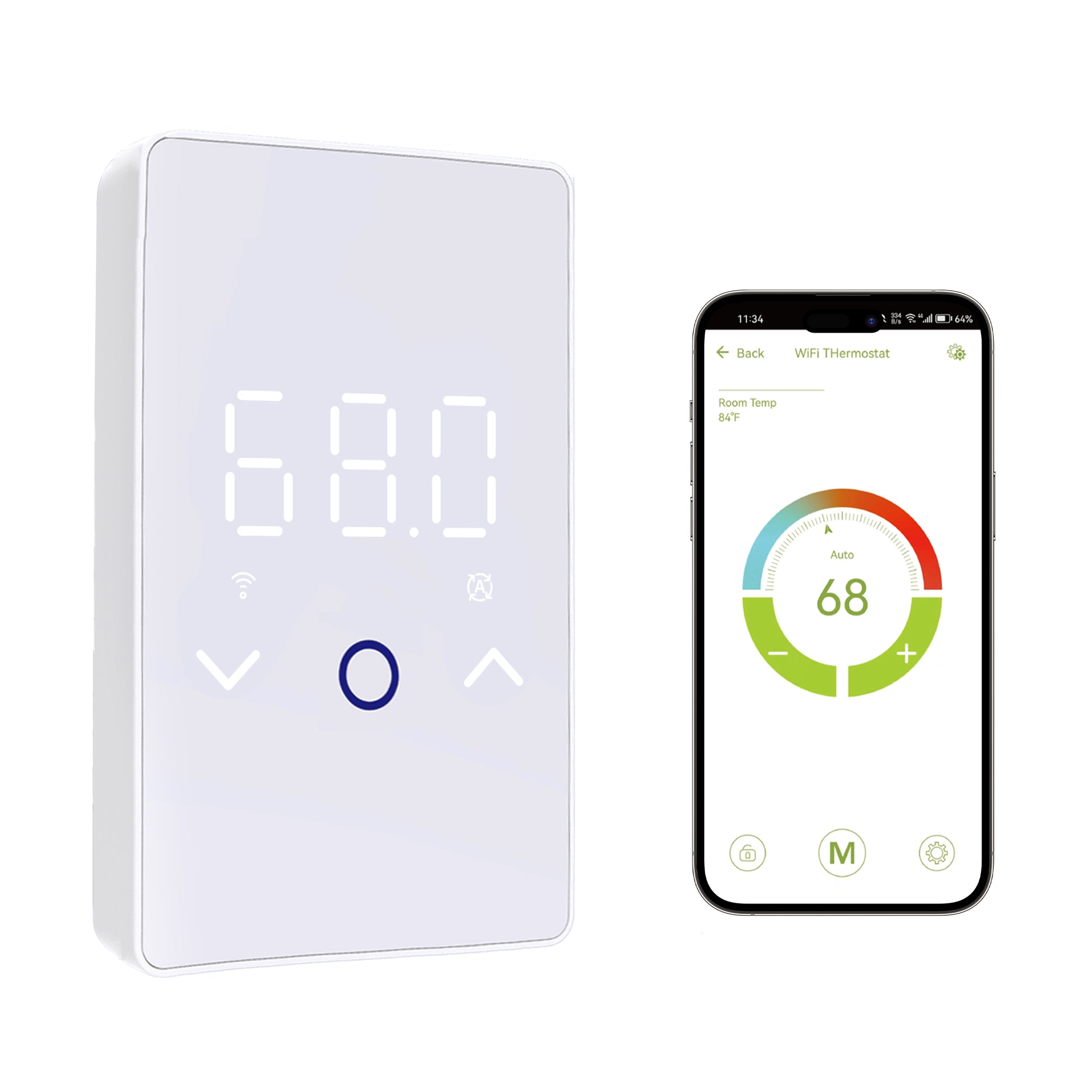
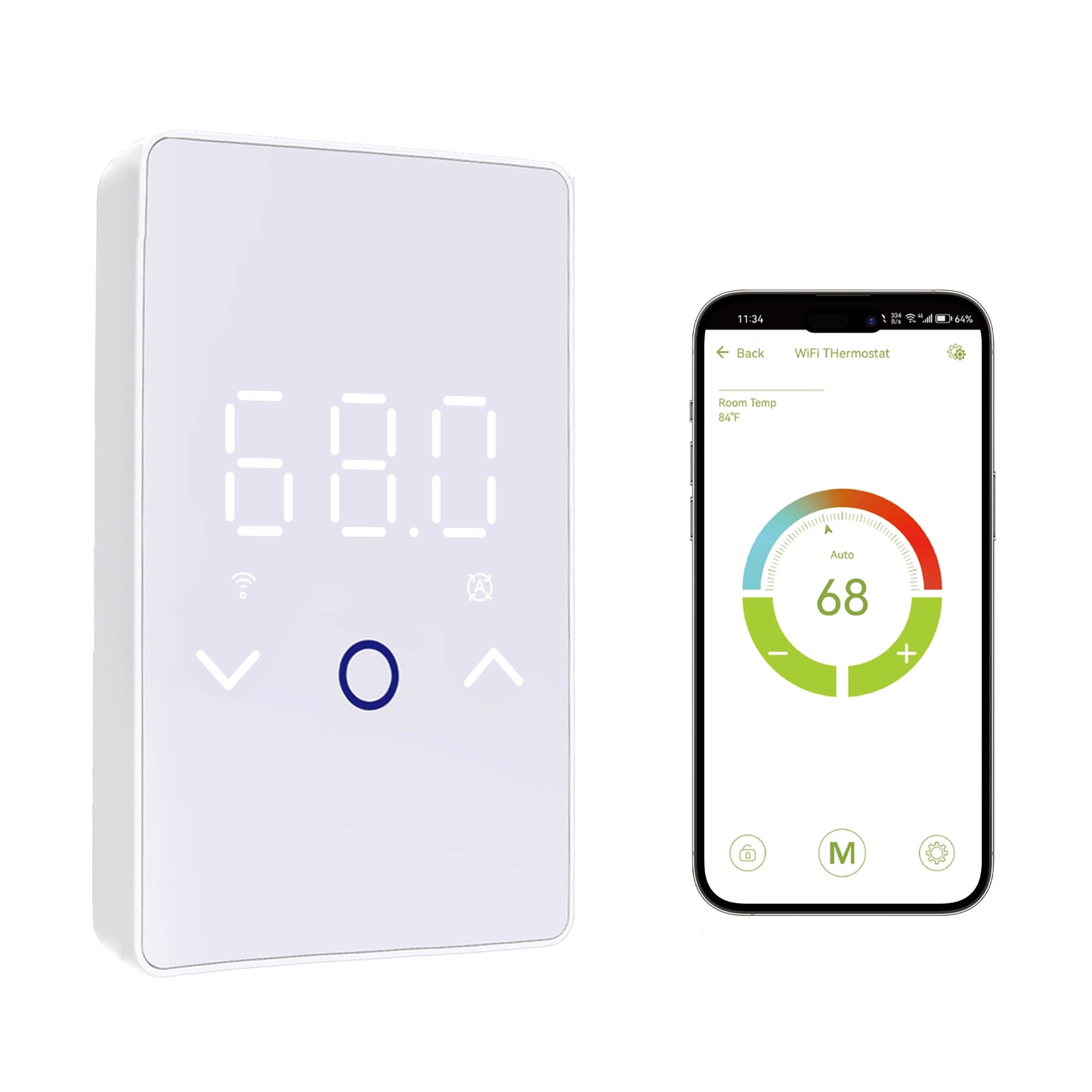
The MAXKOSKO ES29AW Smart WiFi Thermostat supports Floor Sensor, Room Sensor, and Combined Sensor control for compatible 120V and 240V electric floor-heating systems.
It also provides a configurable floor-temperature limit, Room and Floor Calibration, programmable scheduling, Adaptive Heating, and support for compatible replacement floor sensors.
View MAXKOSKO ES29AW Smart Thermostat
Before replacing or installing a thermostat, confirm system voltage, total resistive heating load, wiring configuration, floor-sensor compatibility, flooring temperature requirements, and required ground-fault protection. The current ES29AW supports a maximum resistive load of 15A and does not include built-in GFCI protection.
For compatible heating cables, mats, thermostats, and installation products, browse the MAXKOSKO floor warming collection.
Frequently Asked Questions
What is the difference between Floor Mode and Room Mode?
Floor Mode controls heating from the external sensor installed in the floor. Room Mode controls heating from the air-temperature sensor inside the wall thermostat.
What does Both Mode do on the MAXKOSKO ES29AW?
Both Mode, also called Combined Sensor Mode, uses the internal room sensor for normal temperature control while the external floor sensor limits the maximum floor temperature.
Should I use Floor Mode for tile?
Floor Mode can be a practical choice when floor comfort is the primary goal, but tile alone does not determine the correct mode. Combined Mode may also be appropriate when room-air control and a floor limit are desired.
Should I always use Both Mode with laminate or vinyl?
Do not use a universal rule. Confirm that the specific flooring is approved for electric radiant heat and follow its maximum-temperature requirements. Combined Mode can be useful when room control is desired together with a defined floor-temperature limit.
What floor temperature limit should I set?
Use the maximum temperature specified for the actual flooring and complete heating installation. Do not use the thermostat's highest available setting as the default floor limit.
Can I use Room Mode if my floor sensor is broken?
Room Mode is available as an alternative control method, but it does not directly monitor floor temperature. First troubleshoot the sensor, and confirm that operating without floor-sensor limiting is permitted by the flooring and heating-system requirements.
Why does the floor sensor temperature look wrong?
Possible causes include incorrect sensor type, an incompatible replacement sensor, poor wiring contact, damaged sensor wiring, incorrect placement, or a normal difference between the sensor location and finished floor surface.
Should I use calibration if the displayed temperature is wrong?
Calibration can correct a small consistent offset after the sensor type, wiring, compatibility, and placement have been verified. Do not use calibration to compensate for a large or unstable sensor error.
Does changing to Room Mode make the floor heating more powerful?
No. Sensor mode changes how the thermostat controls the system. It does not increase heating-cable output, heated floor area, or the room's available heating capacity.